Showing posts with label crime. Show all posts

23 June 2015

Being a Special Constable: fighting drug crime

Special Constable Will Liley describes how a Special Constable can play a role in tackling drug crime

One of my most memorable experiences since becoming a Special Constable took place a few months back on a busy Friday evening in Maidstone town centre.

I was taking part in an operation to crack down on drug use among pub and club goers; we visit local social hot-spots, swabbing and testing surfaces for signs of drugs. Sometimes we’ll swab customers too! 

That night, I was in plain clothes acting as a ‘spotter’. This means watching people’s reactions as they’re approached by uniformed officers patrolling with sniffer dogs. 

I was looking out for people who’d immediately turn and walk away, or who’d shiftily play with their pockets – all tell-tale signs they’re hiding something.

Trying to escape
I saw a group of four men stood by a fast food restaurant in Week Street. I watched closely as the officers got closer, sniffer dogs trotting keenly by their sides.

The men froze as soon as they saw them; in a split-second, they’d made a run for it. 

I knew exactly what I had to do. 

Sprinting after them, I shouted out that I was a police officer and called for them to stop; unsurprisingly, they just ignored me. 

The four split up, disappearing through a maze of side roads. I focused on one man, carrying a bag. As I chased him he got quicker and quicker, and I began struggling to keep up.

He grabbed at his bag and hurled it into a nearby wheelie bin. He stumbled, having performed the move at great speed, giving me the extra couple of seconds I needed to catch up. Finally I caught him! 

A great feeling
We fell to the ground as he tried to break free, but I secured him with hand cuffs and placed him under arrest.

My colleagues had seen me give chase and were following closely behind. One of the team pulled the bag from the bin; we found drugs, drug paraphernalia and a wallet so full of cash it barely closed.

Later on, his three friends were found and arrested too.

With the offender back in custody, my job was only partly done. His address had to be searched and paperwork completed.

Being a special is a varied and exciting volunteer role. You learn to think quickly on your feet and are driven by a need to protect those in your community from harm. 

The great result that night left me with a feeling of real satisfaction. I’d say to anyone reading this, ask yourself: 'Could I do something really Special?'

Want to find out more about becoming a Special Constable? Get details of the next Specials recruitment event in Swale on Thursday 23 July.

3 June 2015

National Volunteers Week 2015: being a Special Constable

Responding to a domestic abuse call

To mark National Volunteers Week, Special Constable Nina Johnson* describes a night of volunteering she'll remember for ever


It was dark when we arrived around 10pm. We couldn’t find the entrance at first - neither could the paramedics. Eventually we found the door down a dark alleyway and across a narrow rear yard.

We knocked. No answer. We knocked again.

A figure appeared behind the glass panel and unlocked the door. I could only see her silhouette, framed by a dim light from the kitchen behind her. She spoke, but I couldn’t make out her words. Then she turned her face to the light and I understood why.

Jennifer’s* eyelids were purple and swollen; her top lip was split in half right up to her nose. My insides were churning as I tried to comprehend why anyone would do such a thing; a mixture of anger, empathy, incredulity and urgency all rose within me.

But I had to control my emotions. I’m a Special Constable and the role requires resilience. I have to remain calm and professional, especially in a situation like this.

As gently as possible, I asked her: “Who did this to you?”

With a shaking arm she pointed at a photograph of her and her husband on their wedding day. They both looked so happy in the picture.

I stayed with Jennifer while the ‘regular’ officer I was crewed with checked the flat for any sign of her husband. My radio crackled into life as I heard him update the control room:

“Paramedics are on scene. We’ll need CSI attendance. The bedroom is covered with blood.”


Special support

While the paramedics attended to Jenifer’s wounds, she and I communicated on pen and paper. I learnt some basic details: her husband’s name and the pub he was likely to be at.

We couldn’t talk for long. She needed urgent medical attention and was quickly put in the ambulance to be transported to hospital.

As the ambulance left, Jennifer’s friend Tanya* arrived. It was Tanya who had called the police. She told me she had spoken to Jennifer on the phone earlier that evening, but could barely understand what she was trying to say. From Jennifer’s muffled sounds, Tanya just about made out that Jennifer was at home and badly hurt. So she hung up, called 999 and drove straight to Jennifer’s to help.

From Tanya, I learnt that Jennifer’s husband had been aggressive towards his wife before, and it got worse when he was drunk.

Later that night - outside the pub where Jennifer said he would be - her husband was arrested.
When interviewed back at the station, he admitted beating his wife and was remanded in custody until trial, where he ultimately received a suspended sentence.

When asked why he'd done it, he said it was because she spent too much money redecorating. 

A few days later Jennifer had surgery to reconstruct her top lip.


'I'll never forget'

I’d only been a Special Constable a few months when I responded to Tanya’s call about her friend Jennifer. I won’t ever forget it.

I often wonder what happened next. I hope she is safe and has moved on with her life; I hope she took advantage of the support on offer to help heal the emotional scars, which often endure way beyond any physical ones.

I began my shift the night of Jennifer’s attack with no idea how the evening would turn out. That’s often the way it goes. In the midst of such a horrible situation I’m glad I was able to be there for her; and I’m pleased she had a friend who cared about her enough to call emergency services.

When I signed up to become a Special, like most people who join, I wanted to protect the vulnerable and catch criminals. I think my colleagues and I achieved our goal that night. I’d recommend it to anyone.

If you are affected by domestic abuse, please ask for help. Call us on 999 in an emergency.

Apply to become a Special Constable and help people like Jennifer.

For non-urgent help and advice about the issues in this blog, visit the domestic abuse section of the Kent Police website.


*Names have been changed to protect the victim

24 April 2015

National Stalking Awareness Week - Dos and Don'ts

DC Rachel Freeman
Investigator trainer


Hello all,


Let’s move onto the dos and don’ts if you think you’re being stalked. This is not a definitive list but definitely some things to consider.

  • DO - report the matter to police.
  • DO - contact the National Stalking Helpline for advice and support.
  • DO - let others know about what’s going on.
  • DO - keep records of what has been happening.
  • DO - change your passwords regularly. This can be particularly important if the stalker is an ex-partner who may know your commonly used passwords.
  •  DO NOT - ignore it and hope it will go away. Research has demonstrated the persistence of stalkers. 
  • DO NOT - meet up with a stalker. This could put you at risk of harm, even if you know them. It may also be possible that other people try to make something of the fact that you have met them, jumping to the wrong conclusion.
  • DO NOT - delete messages/voicemails or throw away items you may have been sent – these may be able to be used as evidence. The Criminal Justice System requires evidence and often what you think is irrelevant might be important.
  • NOTE: If you are reading this and have already discarded evidence, don’t worry - it is still important to report the matter and there may be other ways to capture evidence. 
  • DO NOT - isolate yourself by withdrawing from using social networking sites, phones or e-mail. 
  • DO NOT - engage family, friends or anyone else to ‘have a word’ with the stalker. It is rare that such encounters are productive and they can make matters much worse. It might be possible that an offender can use such incidents to make counter allegations.
  • DO NOT - listen to yourself or others when they try to minimise what is happening to you. Stalking is serious and blights people’s lives.
  • DO NOT - immediately change your status on Facebook or other social networking sites if you have just finished a relationship. If the stalker is an ex-partner this can sometimes make things worse.

What not to say to a victim of stalking
People with good intentions can sometimes give advice or make well-meaning comments to victims with detrimental side effects. Here are some of the most common mentioned to advisors at the National Stalking Helpline:

‘You’re being a bit dramatic aren’t you?’, ‘Are you sure you’re not being a bit paranoid?’, ‘I wish I had a stalker’, ‘If they were going to harm you they would have done it already’, ‘If you didn’t look at the stuff, it wouldn’t upset you’

If someone you know talks to you about a situation that is worrying them, it will probably have taken a lot of courage to do so. Try to support them, remember what you’ve read this week and encourage them to come forward so police can investigate.

Thanks for reading,

Rachel


National Stalking Awareness Week - what to do if you think you may be a victim

DC Rachel Freeman
Investigator trainer


Hello again,

Would you know what to do if you are suffering at the hands of a stalker? If the honest answer is no, please keep reading. If the answer was yes, humour me and keep reading as well – there may be something you find useful.

Being stalked or harassed can be extremely alarming and frightening. It is the repetition of the behaviour that makes it even more sinister. Recent advice issued for victims is summed up using the mnemonic REPORT* – hopefully this makes it a little easier to remember.

•    REPORT IT AND TELL OTHERS - contact the police and talk to your family and friends.

•    ENSURE YOU GET GOOD ADVICE - talk to people with experience of this issue -  call the National Stalking Helpline on 0808 8020 300 or visit www.stalkinghelpline.org

•    Be PROACTIVE – keep all messages, gifts, communications, letters, and preserve them. If you are followed in a car, drive through an area where you know there are CCTV cameras. I must stress however that if you feel in immediate danger you should try to find somewhere safe and call 999 immediately.

•    OVERVIEW: KEEP A DIARY - log what is happening including the time, date and details. Once again, it must be stressed, if you feel you are in immediate danger, the diary is no substitute for calling the police on 999.

•    RISK CHECKLIST – once reported, the police will usually ask you questions in order to complete a risk screening checklist. If you think you are at risk, and a checklist has not already been completed, you can download and complete your own. Once completed, pass this to the police for them to consider.

•    TRUST YOUR INSTINCTS AND NEVER MAKE CONTACT WITH YOUR STALKER - if you are frightened or worried, call 999 and go to a safe place. It is advised that victims do not contact or respond to a stalker in any other way. 
    
In my next blog, we’ll look at the do’s and don’ts, the common misconceptions about stalking and advice on what not to say to someone if they think they’re being stalked.

Rachel

*Information reproduced courtesy of Laura Richards. For further information about about her work on stalking and domestic abuse, visit www.laurarichards.co.uk

21 April 2015

National Stalking Awareness Week - the law


DC Rachel Freeman
Investigator trainer

Hi again, hope you’re all having a good day. 

Today I'm going to talk about the specific law
that covers stalking offences.

Before 1997 no specific laws existed to protect someone if they were harassed or stalked. Both police and prosecutors had to rely on a few existing laws to try and bring offenders to justice. That meant some offenders were charged with ‘psychological’ assault. When in court, prosecutors had to prove that the assault caused some appreciable psychological harm, which wasn’t always easy.

Many felt that the existing laws did not protect people enough, and as a result the Protection from Harassment Act 1997 was passed.

This Act was later criticised because of its tendency to deal with more minor incidents so on 25 November 2012, specific stalking offences were added.

If you want to read more about the legislation itself, the
Crown Prosecution Service has more information.

Harassment covers two separate offences:

•    'causing alarm or distress'
•    'putting people in fear of violence'.

These offences are subject to a course of conduct, which simply means there must have been at least two incidents. If there haven’t been two or more incidents already, police can consider using, where appropriate, existing offences and/or a warning to the offender. 

Harassment can mean an unwelcome verbal or written communication, sexual harassment, racially/religiously aggravated harassment, psychological harassment, threats and damage to property.

The new stalking offences sit on top of the two harassment offences I’ve just mentioned. The Act now lists the following, although not exhaustive, as a number of behaviours associated with stalking:

•    following a person
•    contacting or attempting to contact by any means
•    publishing material relating to the victim or seemingly by the victim
•    loitering in any place
•    interfering with any property in possession of someone
•    watching or spying on a person
•    monitoring that person using electronic communication

Importantly, the new section creates TWO offences relating to stalking. Where stalking which by its nature causes the victim to fear violence and; when stalking causes someone serious alarm or distress that has a substantial effect on their day-to-day lives, for example changing jobs, changing routines, moving house and so on. 


In my next blog I’ll be providing some advice if you think you may be the victim of a stalker.

Goodbye for now.
Rachel

20 April 2015

National Stalking Awareness Week - help is available.


DC Rachel Freeman
Investigator trainer


Hello there,

I’m Detective Constable Rachel Freeman, one of Kent Police's trainers. I regularly work with officers to make sure they are up to speed on the latest legislation so they can better support victims of crime.

I will be publishing a series of blogs every day this week – National Stalking Awareness Week
– to help you understand the issues involved around stalking. So if you feel you may be a victim, or know a victim, I hope this will help.

Here’s an idea of what I’ll be covering this week.

I’ll let you know about the current stalking and harassment laws, explaining them as straightforwardly as I can so you know how we can help, and understand the support that is available for victims.

Over the course of the week I’ll also post about what to do if you think you may be suffering at the hands of a stalker, things you shouldn’t do and why, information about diary logs as well as looking at the different types of stalking, such as digital and cyber stalking. 

Whether you think you may be a victim of stalking or have never experienced it, please keep reading. It might be that a family member, friend or even a colleague experiences it in the future. Hopefully you’ll feel better placed to help someone find the courage they need to come forward to the police and get the help they need.

Any victim of stalking will tell you how distressing this type of offending is - and no one should have to deal with it on their own.

If my work this week gives at least one victim the confidence to come forward then it will have been worthwhile.
Until my next post, why not watch this video on stalking from the Suzy Lamplaugh Trust, the UK’s personal safety charity.

Thanks for reading… stay tuned.

28 May 2013

Focus On... Crime Scene Investigation - 'more than meets the eye'

Mark Walsh | Principal CSI


Hi all – hope you enjoyed Phill’s blogs last week. If you missed them you can read them using the links on the right-hand side of this page.

Right, back to the blog…

Forensic evidence is the main tool for solving crime for all police forces. But we don’t always walk away from a scene with forensic evidence that will identify an offender. Physical evidence is not the only thing we are looking for. We also assess how crimes are committed and from that can link scenes and identify offenders through similar offences. 

Vehicle crime is a great example. Say several cars have been broken into. CSIs may only find good forensic evidence at a few of the scenes but due to other circumstances (we can’t tell you this bit, sorry!) we can double check fingerprint lifts against other scenes and solve more than one crime at a time.

Recently we got a DNA match on an offender in relation to a vehicle crime who then admitted over 30 similar offences even though no evidence was obtained at some of the other scenes – a good result. 

Of course a CSI would prefer to find evidence at all of the scenes they attend – this is something that you, as potential victims, can certainly help with. Preserving scenes is absolutely essential, giving us the best chance to find the proof we need to bring offenders to justice.

We do know how distressing being the victim of a burglary can be.  If you are unfortunate to find yourself in this situation, the best action you can take to assist us is:
  • try to identify where and how the burglar got in    
  • look at what items have been moved - this will establish which rooms have been entered and searched
  • do not to touch anything – if you have to move items let the CSI know on their arrival - but please be aware, touching items may mean forensic opportunities are reduced
  • contrary to what you see on the TV, picking up items with cloths and gloves can wipe off fingerprints
  • check to see if the burglar dropped an item of their own property – are there items in your house you do not recognise?

When you call 999 or 101 our Control Room call handlers will give you scene preservation advice. However, often a victim will be too upset or shocked to take that advice on board, and we understand it is natural to want to search through your belongings to see if anything has been taken. But if I can give you one piece of advice to help us make sure we have the best possible chance of bringing someone to justice, it is this: 

All CSIs have undergone excellent training and will be looking for a large range of forensic opportunities dependant on the crime and the circumstances. We are highly effective and thorough and usually conduct burglary scene searches in less than an hour. That means you are then free to clean up, repair damage and find out exactly what has been stolen so you can inform the investigating officer and your insurance provider. So please help us help you and try not to touch anything if you can.

I’d like to tell you a bit more about our team and what we deal with if I may. 

Our department forms part of the Kent and Essex Serious Crime Directorate, I believe the second largest directorate of its kind in the UK. From criminal damage to murder scenes, we are trained to cope with whatever is required.

We even get involved in unsolved murders and rapes from many years ago and part of the department’s function is to review all forensic evidence and look for new leads that may identify an offender. With the development and refinement of DNA, murders and rapes which were thought to be undetectable are looked at again and new techniques in the world of forensics can result in successful convictions of people who have never even been in trouble with the police before

Other rapes and murders have been solved by re-analysing extracts taken from victims’ clothing over 20 years ago. Sometimes very small but significant amounts of DNA have resulted in offenders being identified – something even the scientists at the time would not have dreamed possible.

Looking for new forensic leads to solve historic cases has to be one of my favourite parts of the job. Most of the cases are from the 1980s when DNA was in its infancy as a crime fighting tool and it cost a fortune to use. Just a couple of tests could cost many thousands of pounds - a result may have taken many months to come back and there was no database to compare the results, unlike the facilities we have now. 

To identify offenders from crimes which occurred before I even joined Kent Police is one of the most satisfying feelings you can get from a professional perspective, coupled with the fact that the victims, or victims’ families can begin to get closure on a crime that has haunted them for years.

To be able to delve into these historic cases we need the help of the Kent Police Cold Case Investigation Team. To give you some insight into the fascinating work this team carries out they will be up next in our Focus on… series. Stay tuned.

Thanks for reading.

Mark

24 May 2013

Focus on... Crime Scene Investigation - everyone wants to be a CSI

Mark Walsh | Principal CSI

Hi all,

I’ll start with a little info about myself if I may. I’ve been a CSI since 1991 and since then I’ve progressed to become a Principal Investigator. While it is still a technical role, I also help
with the management of the CSI function to make sure it runs efficiently.

All the work we do, meticulously covering scenes to find evidence, would be wasted if there were no forensic scientists available to examine it. A large part of my role over the last two years has been working to secure new providers to carry out this work for us. It is yet another myth that police forces have scientists in a basement lab waiting to be passed evidence from CSIs (as seen on TV). In fact most is carried out by specialist external companies. By reviewing our providers we have been able to save millions of pounds whilst maintaining the high standards required. 

Recruitment into the team also forms a large part of my role. Everyone wants to be a CSI and I get numerous requests a week, sometimes a day, from people who are interested. The job is not always what people expect – TV doesn’t help this either - and with the shift patterns and distressing crime scenes, a lot of people decide it isn’t for them. 

In this job you cannot predict what will happen next. One minute you could be attending a theft from a vehicle and the next you may have to go to a harrowing scene and end up working long hours on a serious investigation. 

To prepare our investigators for what’s involved; all our staff undertake a comprehensive training programme to make sure they fully understand the role before they go out into the field.

Richard Hunt | CSI Trainer
 
Hi, I’m a trainer here at the Kent Police Training School, where the majority of both our theory and practical sessions are held. We have a purpose built ‘street scene’ containing a Post Office, Estate Agents, pub and houses. They are all set up in the same way as real businesses which really helps our budding CSIs get to grips with scenes that they will attend when they’re in post. The ‘street scene’ gives us the opportunity to create complex scenarios across multiple locations as well. 

We also have a few disused vehicles that we plant evidence in and grassy areas that our CSIs recruits can cordon off and split into sections so they can hone their searching skills.

When recruiting, the trend is to generally source candidates who have already obtained a forensic science degree. With their wealth of theoretical knowledge, our job is to help them convert it into the practical skills required to effectively examine a crime scene. 

In contrast, some of our applicants are already in the policing family and can bring skills and attributes from their previous roles such as excellent communication as well as good recording and searching skills. Their grasp of police speak and procedures can often be a great help too.

Either way our trainers are here to make sure all recruits successfully pass the training programme and have all the skills and determination they need to become a great Crime Scene Investigator.

The long and often unsociable hours do not suit all, but the rewards and the sense of justification I get when an offender is jailed due to evidence I’ve collected is why I return every day and the reason I love my job.  

That’s all for today, tomorrow we’ll let you know about some of the ways we collect evidence, how you can help if you ever find yourself a victim of burglary and talk more about our work with colleagues in the Cold Case Investigation team.

Thanks for reading,

Mark & Richard

23 May 2013

Focus on... Crime Scene Investigation - 'you have to detach yourself from the reality'

Crime Scene Investigator

Phill Pemble


Afternoon all.  Here is another snapshot of the daily work of a CSI. 

I went back to the scene I had left the day before (if you remember, it was an allegation of rape) and took more pictures as the light was much better.

With no more jobs on the work-list I submitted evidence from previous jobs to the lab. I had managed to obtain DNA from clothing of a recent assault victim so I sent that in for analysis. I also sent off some plants that had been recovered from a scene to confirm that they were in fact cannabis and to calculate the potential street value – something that can affect the length of sentence given to drug dealers/producers. I also submitted syringes and other drug paraphernalia for DNA examination. 

Evidence submission came to an abrupt stop when I was asked to attend a burglary scene. A garage at a house had been broken into with an item stolen. Despite searching I could not find any forensic evidence but I spoke to the owners and showed them how this particular incident happened so they could protect against it in the future. I then passed the job back to officers so they could make witness enquiries in the nearby area. 

Back in the office the day quietened down and I carried on with my paperwork – not very exciting but we have to make sure all the proper processes are followed.  

The next day 

Once again the phone was ringing as I walked through the door with a request to attend a sudden death involving a child. As with all instances of sudden death, they can be explained by a range of scenarios, but it is my responsibility to check the scene and eliminate any concerns over the cause. It is important we attend to rule out any involvement by a third party. I gathered the evidence and returned back to the office. 

Next on the list: offenders who had gained entry to a home and stole various items. I managed to recover fingerprints which I really hope will help put a name to the burglar/s. Later I was passed items by officers that were left at another scene and I logged them for testing. You can only hope that in the offender’s hurry to leave they have left proof of who they are. 

What I’ve described to you is a pretty standard week in the life of a Crime Scene Investigator. I hope this has given you an insight into the range of jobs and scenes we attend. Our role is a really important part of the investigative process and we cannot afford to leave any stone unturned. Even the smallest piece of evidence might be the key to a conviction and taking a dangerous criminal off the streets so they cannot continue to harm other people.  

I’m now off for a few well-earned rest days…  

Hope you’ve enjoyed reading. The next blog is from our principal investigator who will be letting you know about what you can do to help us if you ever find yourself a victim of crime. 

Thanks everyone,

Phill

22 May 2013

Focus on...Crime Scene Investigation - 'the highs and lows'

Phill Pemble - CSI

Hi all,

So a typical day… not sure there’s such a thing for a CSI but here goes;
(I’ve removed all references to date, time and location in case any investigations are on-going and to prevent victims from being identified)

I literally got through the door of the office as a Detective Sergeant (DS) came in to let me know of a sudden, unexplained death.

Someone had stopped breathing, paramedics were in attendance and although they made every effort to resuscitate, they had not been successful. As we had details on the individual and knew some of their history, there were some concerns as to the cause of death. I rushed down to the scene along with the local DS and DI (Detective Inspector) and started the examination. During this time other officers began their neighbourhood and family enquiries. 

As always, the first thing I did was photograph the scene before taking a closer look at the body. This obviously isn’t a nice part of my job but it has to be done. If it was a relative of mine I would want to know that the police had done everything they could to determine what had happened. In this case I did not find any suspicious circumstances, so I passed the investigation over to the local coroner. We located some drug taking paraphernalia at the scene which officers seized so they could find out who had used it and what drugs were involved.

Shortly afterwards, I moved onto a shed break-in. With incidents like this I speak to the victims first to establish the circumstances. They were able to show me how they believed the offender did not activate their security light. I took the evidence back to the lab for analysis and spoke to the victims again about extra home security measures they could put in place to help them feel safer and reduce the risk of being targeted again. Any hits from my evidence is fed back to the officer investigating the crime and, if appropriate, shown to the Crown Prosecution Service to help put offenders before the courts.

Another job came in, this time a very difficult one. We received a report of an alleged rape. I know the effect that this type of crime can have on victims having spoken to many over the years so I pay extra attention to even the smallest detail, sometimes it’s all that’s needed to secure a conviction. 

Officers on patrol quickly arrived at the home of the person who made the report to obtain a statement and I sealed off the area where it was reported to have happened and began searching. With reports like this I could be looking for a range of things, so the available light is a huge issue. It was getting dark quickly so I made the decision to leave and return again in the morning.  

Before I leave you for today, I would like to mention crime scenes and the taped off areas you may come across from time to time. 

Please don’t be alarmed when you see this. Even if a CSI is not there, you will see a police car or officer patrolling just to make sure no one tampers with the scene. I will seal off areas
for a range of offences from drug taking to assaults; some may stay up longer because of diminishing light, workloads, dense areas and so on.

They may look alarming but it is critical we make sure any evidence is located so our officers have the best possible
opportunity to bring an offender to justice.

Thanks for reading.  Tomorrow’s blog – ‘you have to detach yourself from the reality’

Phill

21 May 2013

Focus on...Crime Scene Investigation - '12 years at a glance'

Victim's burnt out vehicle
Phill Pemble | Crime Scene Investigator

Afternoon,

Hope you all had a nice evening yesterday.

I have a few memorable jobs from the last 12 years, too many to go in to fully, but the main ones that stick in my mind are:


Jan 2006 – the murder of a couple at their home in Swale

Footprint in the property
I spent nearly two weeks at the main crime scene piecing together what had happened. It was winter, and freezing cold, but both my colleague and I worked tirelessly and managed to produce a computer generated reconstruction. 

We painstakingly covered every inch of the scene to find fingerprints, shoe-marks and DNA evidence. 

Together with the reconstruction the court and jury were shown what happened on that day. It later secured the conviction of a local man and a jail term of two life sentences.
Footprint in the snow
 

See part of the reconstruction that showed the jurors how the offender gained access to the property - http://www.youtube.com/watch?v=fosdWH4wMcI


Feb 2012 – fatal industrial accident

An unmanned fishing boat was recovered near Whitstable, having nearly collided with another vessel. RNLI were tasked with searching the area as were RAF search crews. A body of a man was later recovered from the sea near to where the boat was found. 

As our officers had identified that a second man was supposed to be on-board the vessel I worked with our marine unit to examine the boat in case a crime had been committed while others searched for the missing person. 

This was an unusual crime scene and I learnt a lot from the experience. Unfortunately the second man’s body was later recovered in the Thames Estuary.

 
February 2006 – Tonbridge robbery

A huge case for Kent Police. If you managed to not catch this on every news channel at the time, a group of offenders wearing latex masks and dressed as police officers kidnapped an employee and his family before gaining access to a cash depot and stealing £53million. This was a serious and organised crime involving kidnapping and live firearms which is not something we usually come across in Kent. 

Although not involved in the main crime scene, I was tasked to
work on several additional ones. I examined cash and bags that had been recovered by our officers following the robbery itself, as well as one of the vehicles used by an offender and a vehicle used to hold the staff member's family. 

Evidence collected included DNA on a cigarette butt found at the bottom of a black bin liner that matched one of our suspects, DNA on ripped up latex masks that also placed two more at a scene, and a mobile phone covered in fingerprints, securing the conviction of three offenders.

Seven people were convicted in total and jailed for 183 years combined. Forensic evidence is always crucial - through thorough searches and detailed scene preservation our findings in this case in particular proved vital, a great success for our team.


July 2010 – methamphetamine production in a residential garage in Whitstable

This again was unusual for Kent and after the find was located, I worked alongside other specialist agencies including the Serious and Organised Crime Agency’s Hazardous Lab team and Kent Fire & Rescue Service to dismantle the production facility. 

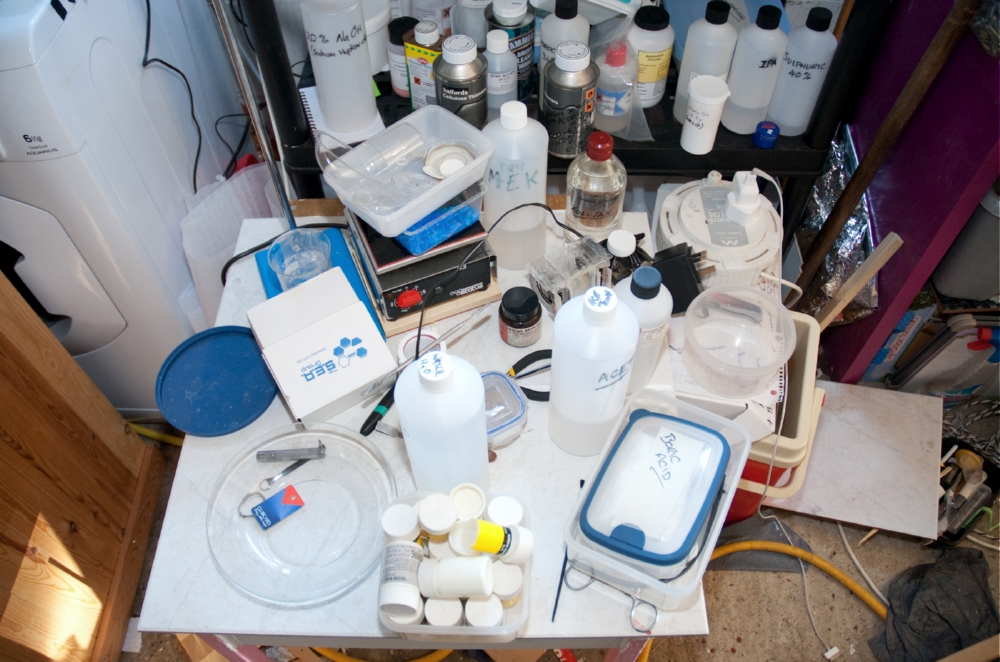
Meth ingredients are often toxic and volatile, for example acids, red phosphorous and ammonia, and we all needed to take extreme care to ensure the safety of not only ourselves but the surrounding residents before deeming the area usable again. 


Coming up tomorrow - a day in the life of a CSI. I’ve put together a few blogs to give you a real insight into a typical day. 

Phill